
Industrial Model Making: Types, Uses, Materials and Process
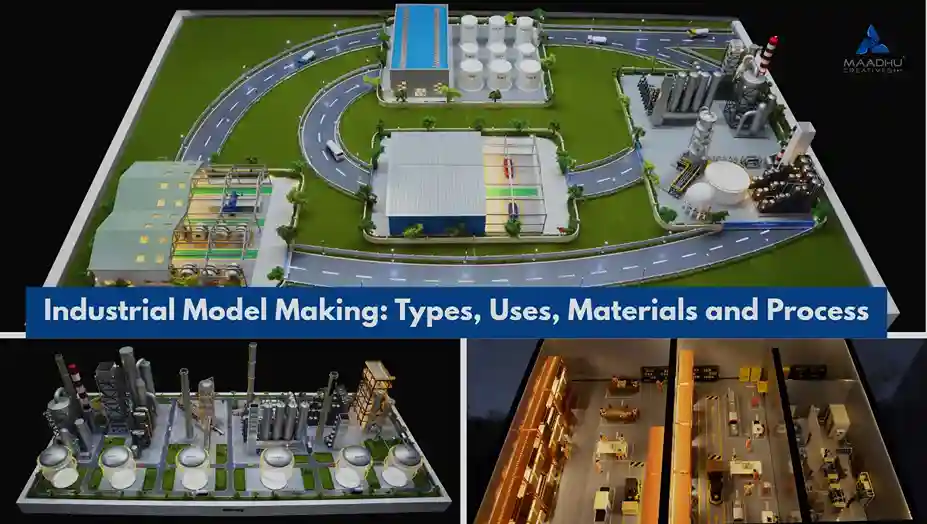
Industrial model making means building accurate small-scale versions of plants, factories, pipelines, equipment and ships, so anyone can grasp a project at a glance. Engineers read drawings with ease. A board, an investor or an exhibition visitor usually cannot, and a physical model closes that gap. These models help engineers, business owners, investors and visitors understand complex projects more easily. This guide covers the types of model, where they are used, the materials, our process and how to choose a maker.
What Is Industrial Model Making and Why Is It Important?
An industrial model is a scaled, physical copy of a facility or machine, built from the project's own drawings. It shows how buildings, tanks, pipe racks, conveyors, jetties or decks relate to each other. Industrial scale models and industrial miniature models exist to explain a project, not to test it.
That separates them from two things people often confuse them with.
Model, Render or Prototype?
Render or walkthrough: An image or film on a screen. We make these too, but nobody can walk around one.
Product prototype: A part or product made to test fit, form or function, often 3D printed.
Industrial model: A representation of a plant, site or ship, built to communicate a layout or a process.
Boards, investors, exhibition visitors and EPC teams who cannot read drawings get the most from these models. Everyone sees the whole project, points to a part and asks a question.
Types of Industrial Models and Where They Are Used
Factory Model and Factory Scale Model
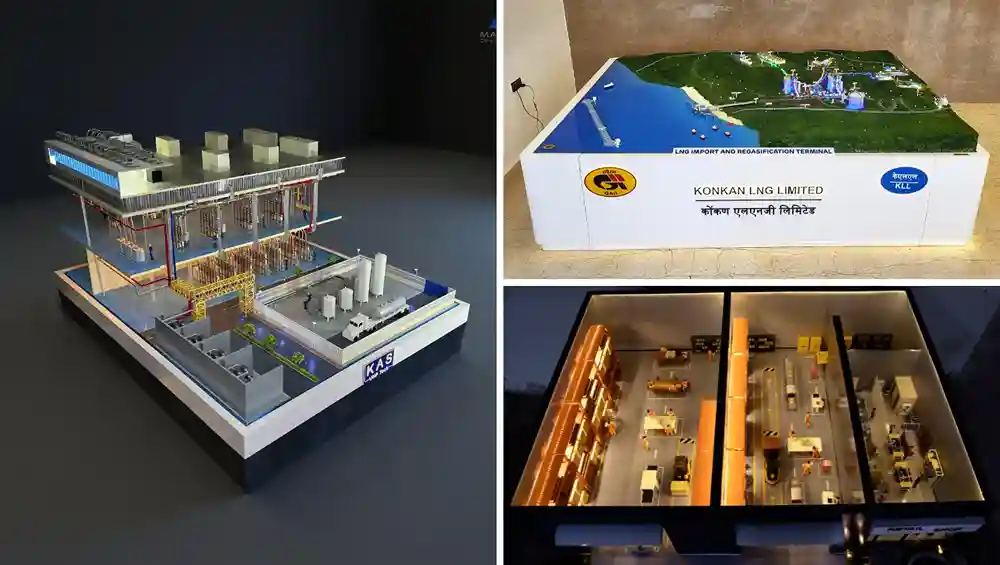
A factory model shows a complete facility: sheds, roads, utilities and storage areas. A factory scale model is usually built at a small scale such as 1:200 or 1:500. The whole site then fits on one table, and the flow of people and material is easy to follow.
Industrial Plant Model and Piping Model
An industrial plant model concentrates on process: towers, tanks, structures and pipe racks. A piping model goes deeper into how lines run and connect, so teams can discuss routing and access.
Equipment, Marine and Miniature Models
Equipment models explain a single machine or skid at a larger scale. Marine and offshore models show ships and rigs in one look. A miniature factory model is a compact version made for a boardroom or showroom table.
Which Type Suits Which Purpose?
Whole-site layout: factory scale model
Process and equipment planning: industrial plant or piping model
One machine for a stand: equipment model
Ship or rig: marine or offshore model
Boardroom or showroom table: miniature factory model
Where These Models Are Used
They turn up in boardroom and investor presentations, site offices, exhibition stands and plant layout reviews, and they help explain a plant or ship to visitors or trainees. Buyers come from oil and gas, power, pharma, marine and engineering firms. Clients whose logos appear on our website include Reliance Industries, ONGC and Adani Power.
Materials and Finishing
Each material has its own job:
Acrylic and plexiglass: Clean pipes, tanks and structures, and transparent parts.
High-density polyurethane: Terrain, buildings and larger solid masses that need shaping.
Wood and veneers: Bases, display tables and warm detailing.
3D-printing resins: Small, detailed parts such as valves, fittings and equipment.
LED lighting and moving parts are available on request, for example to pick out a process area. Painting and finishing, plus gold or chrome plating, give metal parts a realistic look.
Choosing a Scale
Scale follows the size of the site and the detail you need to show.
1:500: A whole site, with buildings as clean masses.
1:200: A factory where buildings, roads and yards stay readable.
1:100: A plant unit where structures and piping must be visible.
Treat these as starting points. The team will advise once it has seen your drawings.
How an Industrial Model Is Made: Our Process
At Maadhu Creatives, every stage of industrial model making is managed in-house, from drawing review and fabrication to painting, finishing and final assembly.
Drawing check. We can start from DWG or DXF CAD drawings, SketchUp, Rhino or Revit models, hand sketches, photos and material references. The team checks them first.
Laser cutting and 3D printing. Flat parts are laser cut. Complex parts are printed using SLA, FDM or DLP.
Fabrication and electrical work. Parts are built up, and lighting or moving parts are wired in.
Finishing and painting. Surfaces are finished and painted to match your references.
Final assembly. The model is put together and checked as a whole.
You approve the work from anywhere on HD photos and video, and you can visit the workshop by appointment. A model that travels goes in a custom crate or flight case with insured shipping, and delivery and installation can be arranged. We keep your project drawings and technical details strictly confidential at every stage of production.
How to Choose an Industrial Model Maker
Factory model makers and other industrial model makers do not all work the same way. A good industrial model maker checks your drawings before quoting. Look at these points.
Capability
Ask whether laser cutting, 3D printing, fabrication, lighting and finishing are done in-house. When one company handles all of them, fewer hand-offs happen between vendors.
Proof
Maadhu Creatives has completed 2000+ projects for 1000+ clients, and 95% of clients come back (as stated on our website). We work for clients in 22+ countries from offices in Mumbai and Dubai.
Our experience also includes detailed engineering models such as Pump Skid and E-House models, which demonstrate how complex industrial equipment and systems can be presented through physical scale models.
What Shapes the Quotation
Any industrial model making company should be able to explain what drives the price:
Scale and size
Level of detail
Lighting
Moving parts
Urgency
We do not quote prices in articles, because a person sends the quotation. The team can suggest a scale or level of detail that fits your budget, and an expedited schedule is confirmed in the quotation. If you are comparing makers, send your drawings and the team will reply with a quotation.
FAQs
What Is Industrial Model Making and Who Needs It?
It is the building of physical scale models of plants, factories, pipelines, equipment and ships. Developers of industrial projects, EPC teams, engineering firms and exhibition organisers use them to explain a project to people who cannot read drawings.
What Is the Difference Between a Factory Model and an Industrial Plant Model?
A factory model shows the whole facility, including buildings, roads and yards. An industrial plant model focuses on process areas such as towers, tanks, structures and piping. Many projects use both, at different scales.
Which Scale Is Best for a Factory Scale Model?
It depends on the site and the detail you need. A whole site often suits 1:500, a factory with readable buildings suits 1:200, and a plant unit with visible piping suits 1:100. The team can recommend a scale after seeing your drawings.
What Files Do Industrial Model Makers Need to Start?
You can begin with CAD drawings in DWG/DXF, a 3D model from SketchUp, Rhino or Revit, or just sketches, photos and material references. Rough drawings are fine. The team checks them first and tells you what is missing.
Can You Make an Industrial Miniature Model with Lights and Moving Parts?
Yes, LED lighting and moving parts are available on request. Tell the team what you want to show, and it will confirm what is possible at your chosen scale.
What Affects the Cost of an Industrial Model?
The main drivers are scale, size, level of detail, lighting, moving parts and urgency. Prices come from a person in a quotation, and the team can suggest a scale or detail level that fits your budget.
How Long Does It Take to Make an Industrial Scale Model?
The time required depends on the model's size, scale, complexity, materials, level of detail and finishing requirements. Once the team reviews your drawings and project requirements, it can provide an estimated production timeline.
Looking for a Reliable Industrial Model Maker?
Maadhu Creatives creates custom industrial-scale models based on your drawings, project requirements, and presentation needs. From factory and plant models to machinery and marine models, our team helps turn complex technical information into detailed physical models. Share your project details with our team to discuss the right scale, materials, and level of detail for your industrial model.
Related Blogs
How to Make a City Model: A Simple Guide
Want to make a city model? Learn how to plan, choose materials, build structures, add details, and create a realistic miniature city.
Read More
Maadhu Creatives
•August 13, 2024
What Is Architectural Master Planning? Complete Guide for Modern Developments
Learn how architectural master planning models help architects and developers present residential, commercial, and landscape projects with clarity and...
Read More
Admin
•July 17, 2026
How to Use Prototyping Models in Scale Model Making
Learn about prototype model making, including types, materials, processes, rapid prototyping, 3D printing, and how prototypes improve scale model desi...
Read More
Maadhu Creatives
•February 24, 2026