

What Is an Industry Model? Understanding Its Structure and Importance

Have you ever thought about why certain businesses thrive while their equals are having it tough in the same sector? One important reason would be how knowledgeable a business is regarding the industry it’s operating in.
An industrial model gives a clear insight into how a marketplace works, thereby helping a business to know its rivals, buyers, and suppliers as well as the price structure, technology, policies, and tendencies in its vertical. An industry model, therefore, can be termed a roadmap that illustrates ways different elements of the industry influence each other and serve the common aim.
This article will unveil the term, structure, main components, types, examples, and significance of an industry model.
What Is an Industry Model?
The term "industry model" is used to refer to a method of explaining the functioning of a specific industry as well as the relationships among its components. The model provides an insight into what is happening in the industry by taking into account business entities, suppliers, competitors, customers, distributors, government regulations, as well as changes in pricing, market demand, and costs.
The construction industry is a good example of an industry model. In the context of this industry, the following components can be distinguished: engineers, architects, material suppliers, machinery providers, transportation companies, and regulations. Any change in one of these areas influences the operations and competition of businesses involved in the industry.
The industry model offers an overview of all these components, rather than studying each of them separately. The purpose of this overview is to provide business entities with insights into their market, provide the necessary information about market patterns and shifts, as well as possible business opportunities and threats.
Why Is Industry Analysis Important?
Before making a major business decision, it is useful to know what is happening in the market.
This is why industry analysis is important.
Industry analysis is the study of the factors that affect businesses engaged in a particular industry. Knowing this information is useful for understanding where the industry is heading and what opportunities/challenges might arise. A business that thinks about becoming part of a new industry should be aware of the following information:
Who are the main competitors?
What do customers expect?
Is demand increasing or decreasing?
How difficult is it for new businesses to enter?
What are the major industry trends?
Are new technologies changing the market?
What regulations could affect the business?
What are the biggest risks?
Finding answers to these questions can help a company avoid making decisions based only on assumptions.
Industry analysis is not crucial only to new businesses. Established companies can also benefit from it in order to adapt to changes in customer behavior, technologies and competition.
Why Is Industry Structure Important?
Every market has its own unique industry configuration, which accounts for the organization of companies and their rivalry with each other. There are industries where a small number of big companies operate, as well as those with thousands of small and medium enterprises.
Industry configuration has an impact on competitiveness, pricing, profit generation, and reasons behind consumer choices, as well as easiness of entering some markets. For instance, some industries require big investments in a costly equipment, efficiencies in the use of high technology, specialized but costly skills, or other licenses.
At the same time, industries with low entry barriers can be more competitive. Understanding industry configuration allows businesses to evaluate their market positions, analyze competition intensity, identify opportunities, and create more rational long-term strategy.
Main Parts of an Industry Model
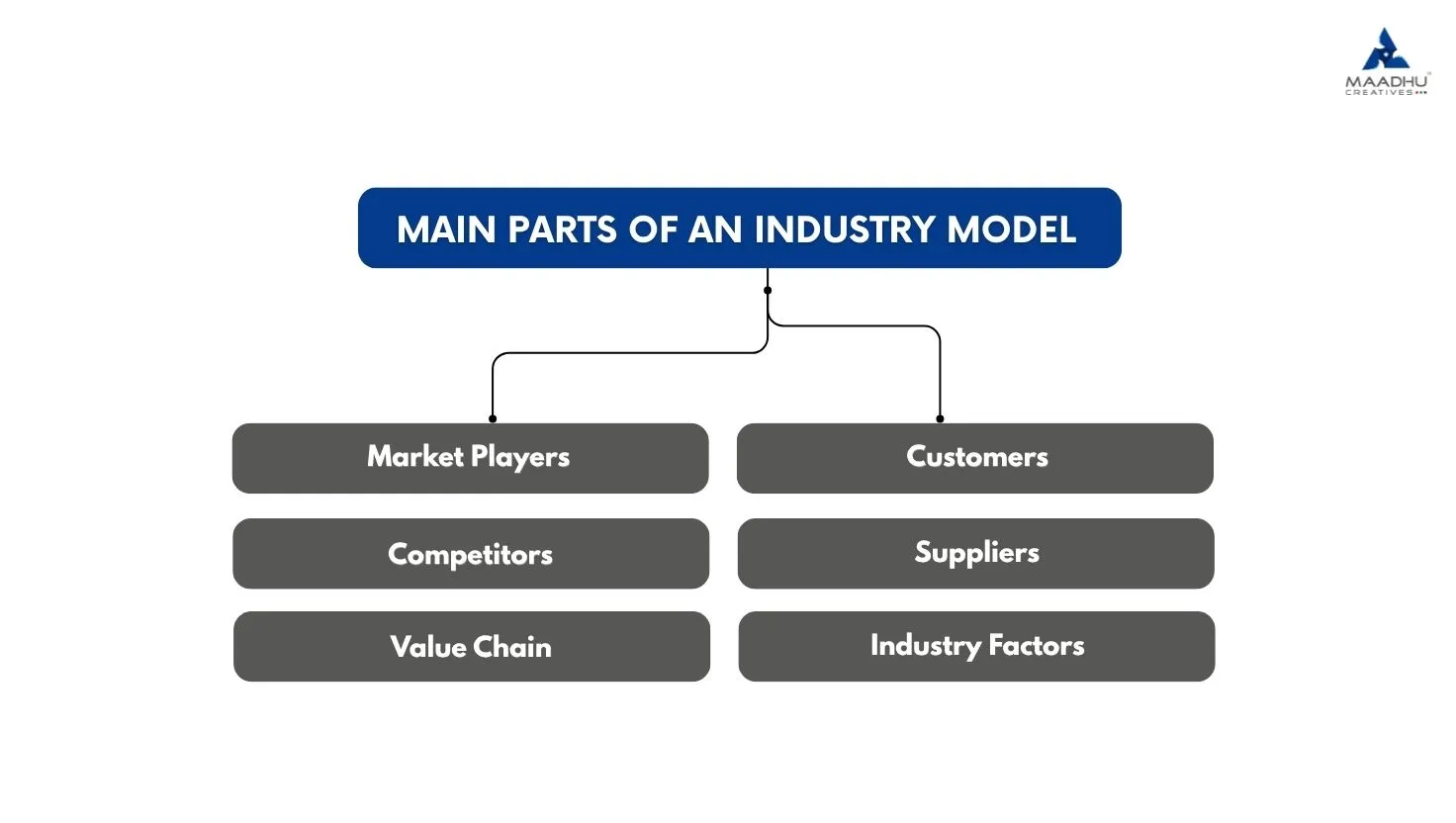
An industry model can include many different elements, but several key components are commonly studied.
1. Market Players
Market players include manufacturers, suppliers, distributors, retailers, competitors, service providers, technology companies and customers.
Knowing who these players are and what they do gives a starting point for industry analysis.
2. Customers
Generally, consumers play a major role in shaping the industry. The choice, preference, buying behavior, income status, and expectations of consumers greatly influence the companies in the industry with respect to the types of products and services they offer and the marketing strategy in place.
3. Competitors
Another key element of an industry model is competition. Companies compete on pricing, quality, service, innovation, convenience, technology or brand image.
Looking at what the competition offers, a business can find out what’s available and where it can provide something unique.
4. Suppliers
Suppliers are the companies that provide the company with the things it needs. This could be materials, products, equipment, technology or a service.
Where an industry is reliant on only a few suppliers, then any changes in supply or price can have a major effect on the firms. Supplier relationships are therefore an important part of understanding the industry.
5. Value Chain
Value chain refers to the different stages throughout the process of producing and delivering a product or service. A manufacturing company, for instance, may rely on suppliers of raw materials, production facilities, logistics providers, distributors, retailers and customers.
By looking at the value chain, organizations can understand where value is created and where costs occur.
6. Industry Factors
A range of external industry factors can influence the market.
These may include:
Technology
Government regulations
Economic conditions
Customer preferences
Raw material costs
Labor availability
Environmental requirements
Global competition
Social and cultural changes
Some factors may create new opportunities, while others may introduce new challenges.
Different Types of Industry Models
There is no one model for each industry. What model you need depends on what the company needs to find out.
Competitive analysis looks at competitors, pricing, market share, and barriers to entry. The value chain model analyzes how products or services are made and delivered. The market structure model considers competitors, size, customer power, and supplier power. The industry trends model focuses on technology, customer taste, sustainability, and market changes. The industry forecasting model allows you to investigate the future demand, competition, and growth of the industry.
The aim is to determine the model that allows you to conduct the industry analysis most effectively.
Real Examples of Industry Models
The automobile industry can be a great illustration of how an industry model could evolve in time. In the past, the business was concentrated on fuel-powered vehicles and large-scale manufacturing. Dealerships, traditional suppliers, and existing distribution models.
The rise of electric vehicles has altered the landscape of business. Technology for charging, battery technology software, new suppliers along with government policies, and shifting customer expectations play a larger role. These changes have led to new opportunities, while also increasing competition.
The media industry has undergone the same change. Television, newspapers and other physical media depended heavily on subscriptions, advertising as well as physical distribution. The evolution of streaming services and digital media has transformed not only the way people consume their media but also the way companies make money.
These examples demonstrate the fact that any industry model isn't indefinite. Technology, customer behavior regulations and economic circumstances can continually alter an industry's structure and open up new opportunities and new challenges.
Why Understanding Industry Models Is Useful
So, why should a business spend time understanding its industry?
The simple answer is that better information can lead to better decisions.
For a business proprietor, an industry model can serve as a guide for identifying opportunities, competition, threats, and changing customer needs.
For an entrepreneur, the industry model can provide an answer to whether a business concept has market potential and whether it is worth taking on competitors.
For an investor, understanding industries through analysis can potentially bring insights when trying to assess firms and their business environment.
Finally, an industry model can assist a business analyst in comparing companies, determining trends, and studying market changes.
Industry models can support decisions related to:
Entering a new market
Expanding a business
Developing new products
Setting prices
Understanding competitors
Planning investments
Managing risks
Creating long-term strategies
The aim is not to foresee every event taking place. Markets shift continuously and there is not any model that is capable of providing precise predictions.
Instead, the industry model functions to ensure understanding of current situation and safeguard against future shifts.
Industry Model vs. Business Model
Industry model and business model may look alike on the surface, but they pay attention to different factors.
The business model sheds light on the means used by the company to create value, serve its clients and make profit.
On the contrary, industry model studies the condition of the whole market and its different forces acting on business.
For instance, the business model of a software company, which makes profit based on subscription payments, means that the customers are charged for the use of software.
The industry model regarding the software industry would start from analyzing the whole market and taking into account competitors, demand among the clients, pricing trends, the use of technology, legislation, suppliers and overall growth of the industry.
In other words, business models study one company, while industry models analyze many companies and their environment.
How to Create a Simple Industry Model
Creating an industry model does not have to be complicated.
First, identify the sector you are interested in analyzing. Secondly, form the list of the most important corporations, and customers, suppliers, rivals and other players in the industry.
In the next step, analyze the industry structure. Investigate competition, volume of demand, pricing philosophy, obstacles to entering the market, and relations between suppliers and consumers.
Next, investigate external factors influencing the industry under study: technologies, laws, current economic situation, and customer behavior.
Finally, analyze the existing trends in the industry and forecast its future.
The purpose is not to predict the future perfectly. The purpose is to build a clear understanding of the market so that business decisions can be made with greater confidence.
Final Thoughts
An industry model provides businesses with insights on how the market operates. The paradigm of industry model takes into account the competitors, customers, suppliers, technology, demand, and trends that are happening currently in the industry.
Having knowledge about these areas, companies will be able to find the opportunities that help them deal with challenges, and make optimal choices. Industries evolve constantly in the wake of advancements in technology, shifting customer preferences, and emergence of new competitors in the market. Regular industry analysis ensures that companies are ready to adapt and grow over time.
FAQs
What is an industry model?
The concept of an industry model is used to refer to a concept that serves as a foundation for understanding the industry. It takes into account competitors, technology, customers, market and any other aspects that affect an industry.
What is the difference between an industry model and a business model?
Business model formulates the ideas of how one particular company gets its income and generates value, while industry model investigates the overall market situation and refers to the forces influencing many companies.
Why is industry analysis important?
Industry analysis allows a company to understand its competitors, the market demand, market trends, threats, and possibilities.
Can an industry model change over time?
Yes, industry models change because of the appearance of new technologies, shifts in consumer demand, legislative issues, economic situation, market competition, and so on.
Related Blogs

Understanding Scale Model Making Costs: A Complete Business Guide
How much does scale model making cost? Explore the factors that impact pricing and learn how to choose the right scale model solution for your project...
Read More
Maadhu Creatives
•June 20, 2026

What Does a 3D Model Maker Do? Roles, Skills, Process & Uses
Learn what a 3D model maker does, how 3D modeling works, where it’s used, and how to choose the right professional for your project.
Read More
Admin
•September 02, 2026

How to Create a Stunning Handmade Diorama Step by Step
Discover how to create a stunning handmade diorama step by step with realistic miniature detailing, painting techniques, and expert DIY tips.
Read More
maadhu creative
•October 28, 2025
