
Types of Scale Models: A Complete Guide to Scale Model Types
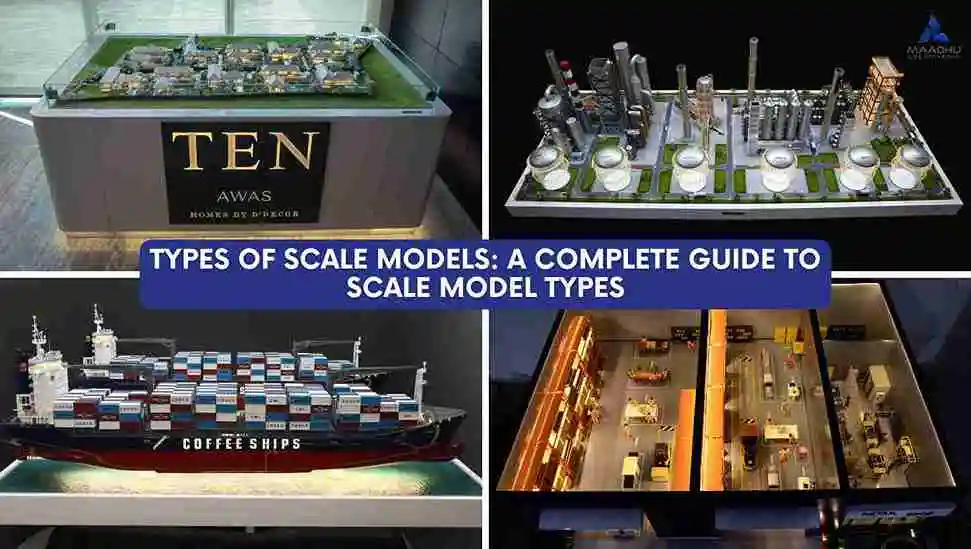
A scale model turns a drawing into something people can walk around and point at. It is a physical copy of a building, plant, ship or site, built at a fixed ratio to the real thing. Below you will find the main scale model types, an explanation of ratios and materials, and the questions worth asking before you order one.
What Is a Scale Model and Why Do Projects Need One?
Every length on a scale model is the same fraction of the real length. Proportions, distances and the relationships between parts stay true. Only the size changes.
Most buyers, investors and board members cannot read technical drawings with confidence. A model removes that barrier. In a single look, people see the height of a tower, the gap between two blocks or the route of a pipeline.
Our team makes renders and walkthroughs as well, and they have their place. But they live on a screen. A physical model sits on a table, and people gather around it, lean in and talk about it from every side.
Typical uses include:
sales galleries and project launches
exhibitions and museum displays
board presentations and client meetings
training and technical demonstrations
The people who commission them are real-estate developers and architects, industrial, oil and gas and power companies, marine companies, infrastructure teams and engineering firms.
Scale Model Types: Architectural, Industrial, Engineering, Marine and More
The scale model types below differ by subject, but each answers one question: what does the viewer need to understand?
Architectural and master plan models
A good architectural model maker builds exterior models, interior models, and block and massing models. The subject might be a single building, a residential complex, a commercial tower or a full township.
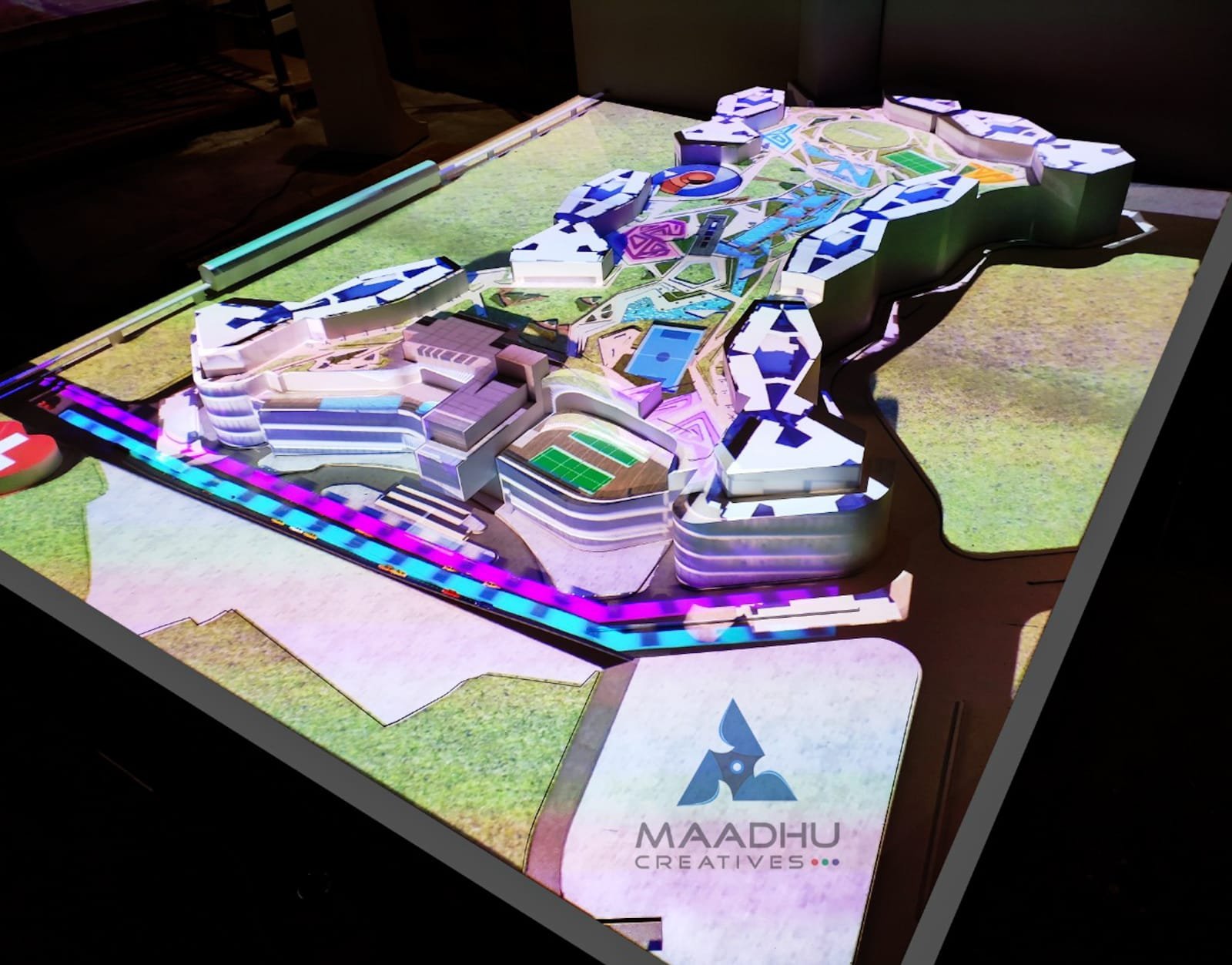
Master plan model making shows the whole layout at once: buildings, roads, landscaping, amenities and other site elements. On a township model, a buyer can find the entrance, the park and the clubhouse, and see how each sits in relation to their own tower.
Industrial, engineering and piping models
Industrial model making explains a plant or facility in one view. Engineering model making covers equipment, infrastructure and technical systems that are hard to describe on paper.
Piping model making goes a step further. It shows equipment, pipe routes, connections, platforms and how the system is arranged. A board, investor or project team can follow a complex setup without wading through a stack of drawings.
Marine models
Marine model making covers ships, vessels, offshore structures and marine engineering. A visitor or investor grasps a vessel or an offshore installation at a glance.
Miniatures and train models
Miniatures and train models are usually static display pieces. When the display calls for it, they can be customised with lighting or moving parts.
Whatever the type, the purpose sets the scale, the level of detail, the materials and the presentation features.
Detail Level and Scale Model Ratios
Massing, semi-detailed or fully detailed
Choose the level of detail by the decision the model must support.
Massing models focus on overall form, proportions, the arrangement of buildings and the surroundings. They suit early planning and concept studies.
Semi-detailed models add key architectural, structural, landscape and presentation elements, without modelling every small component.
Fully detailed models include finer façade features, interiors or technical components. Sales galleries and exhibitions often call for this level.
Extra detail, lighting, moving parts, landscaping and special finishes all add work, and they affect the quotation. Tell us what the model is for, where it will stand and what you can spend, and our team will propose a scale and level of detail to match.
How scale model ratios work
A ratio of 1:100 means one unit on the model stands for 100 of the same units on the real object. So 1 cm on the model is 1 m in reality. At 1:500, 1 cm represents 5 m.
Most of the enquiries we get are for 1:100, 1:200 or 1:500. In general, a larger scale such as 1:100 shows more detail. A smaller scale such as 1:500 lets a large site fit into a practical display area.
The right scale model ratios depend on project size, display space, the detail required, viewing distance and the purpose of the model. Hobby ratios for aircraft, vehicles and kits can differ from professional architectural and engineering scales, so a kit chart is a poor guide.
We confirm the final ratio after reviewing the drawings, site dimensions, display requirements and detail level.
Scale Model Materials and How a Model Is Made
Each of the scale model materials we use has a job:
Acrylic and plexiglass: clean architectural elements and transparent parts.
High-density polyurethane: shaped and detailed parts.
Wood and veneers: selected architectural elements that need a natural finish.
3D-printing resins: small, complex or customised components.
Finishing adds LED lighting, landscaping, paint, surface treatment and, on request, moving parts. The exact material and method depend on the model's size, geometry, detail, durability and purpose.
From drawing to finished model
Scale model making happens under one roof, in these steps:
We check the drawings and references and confirm the scale.
Components are laser cut or 3D printed.
Parts are fabricated and the model structure is assembled.
Electrical work goes in where lighting or movement is needed.
Surfaces are finished and painted.
The model is assembled and inspected.
Inputs can be CAD files (DWG/DXF), SketchUp, Rhino or Revit files, sketches, photographs, reference images and material references. Rough drawings are fine. The team checks them first.
Choosing a Scale Model Maker: Cost, Distance, Confidentiality, Proof
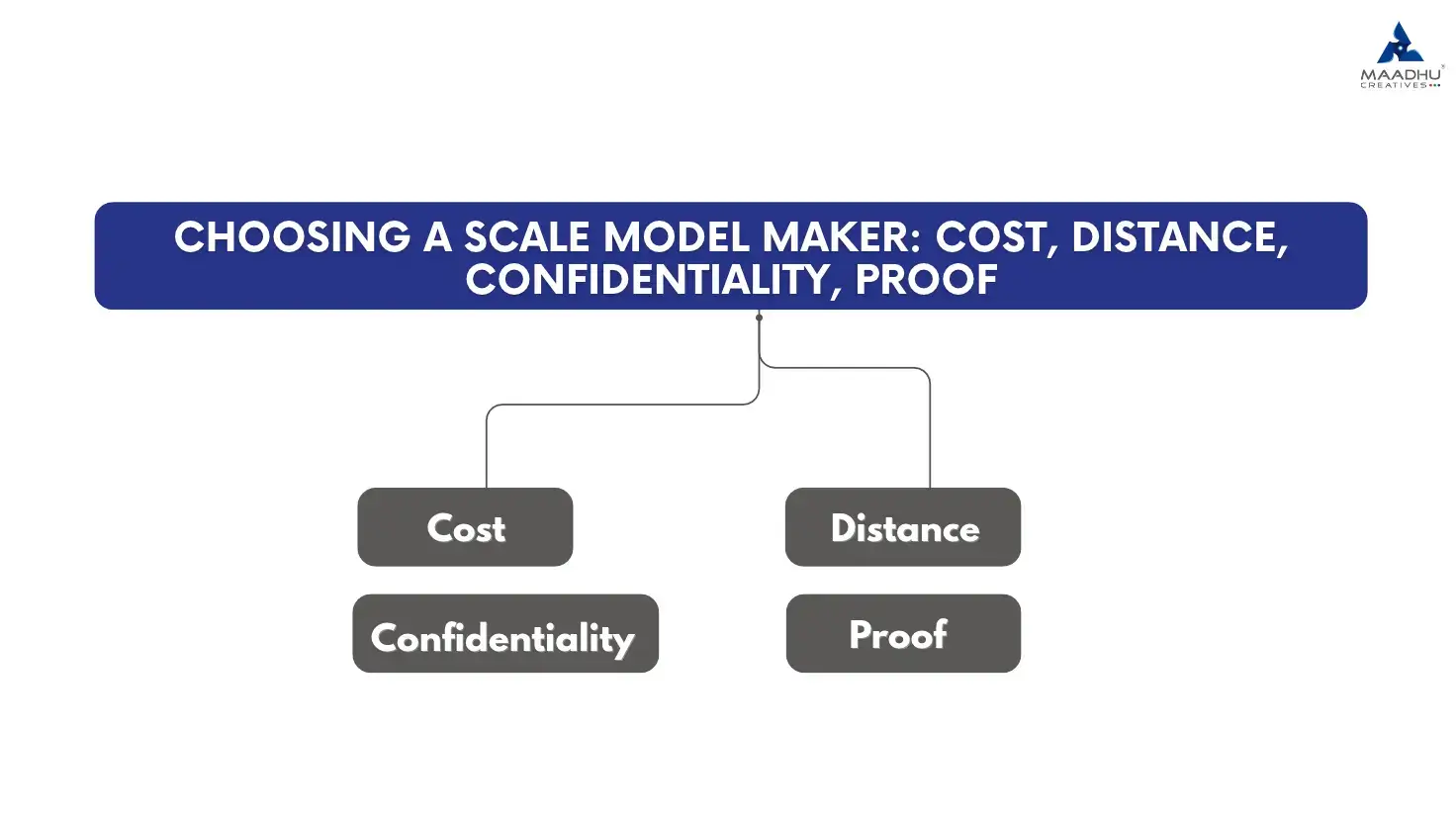
Cost: A quotation depends on scale, model size, detail, materials, finishing, lighting, moving parts, complexity, installation and urgency. Figures come from a person, in a written quotation.
Distance: Approvals can happen on HD photos and video. Every model that travels goes in a custom crate or flight case and is insured in transit, and we can arrange delivery and installation. You can also visit the workshop by appointment.
Confidentiality: We sign an NDA before any drawings, CAD files or technical information are shared.
Proof: Maadhu Creatives has completed 2000+ projects for 1000+ clients, and 95% of clients come back (as stated on our website). We work for clients in 22+ countries from offices in Mumbai and Dubai, in fields such as real estate, energy, shipping and engineering.
If you have drawings, CAD files, reference images or a brief, send them over. We will talk through scale, detail, materials, timeline and quotation with you.
FAQs
What are the main types of scale models?
The main types are architectural, master plan, industrial and engineering, piping, marine, and miniatures and train models. The type follows the subject and what the viewer needs to understand.
Which scale ratio is right for a master plan or township model?
There is no single answer. Large sites often use smaller ratios such as 1:500 so the model fits the display space. Smaller sites may use 1:200 or 1:100 to show more detail. We confirm the ratio after reviewing your drawings and display requirements.
What materials are used in scale model making?
We use acrylic and plexiglass, high-density polyurethane, wood and veneers, and 3D-printing resins. LED lighting and moving parts are added on request.
Can you build a model from rough drawings?
Yes. CAD files, 3D files, sketches, photographs and material references all work. The team checks them first and tells you what else is needed.
Can a model have lighting and moving parts?
Yes, on request. Electrical work is part of the build, and these features are reflected in the quotation.
How are models sent safely to another city or country?
Models travel in custom crates or flight cases with insured shipping. You approve the finished model on HD photos and video, and delivery and installation can be arranged where required.
Related Blogs
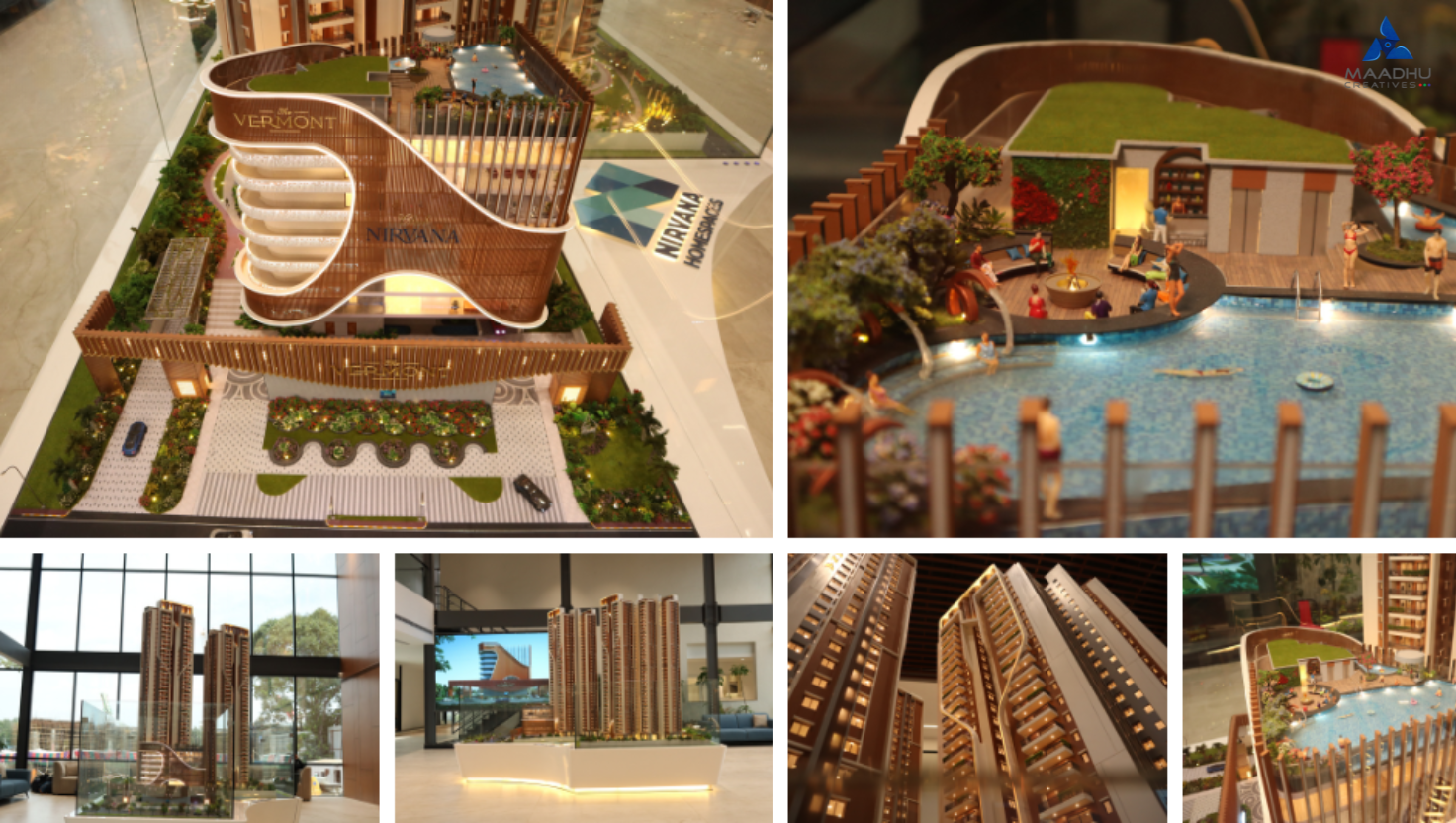
The Ultimate Guide to House Models: Types, Benefits, and Building Tips
Bring architectural ideas to life with house models. Explore scale, 3D printed, wood, villa, and custom models, plus expert tips for creating detailed...
Read More
Maadhu Creative
•August 28, 2024
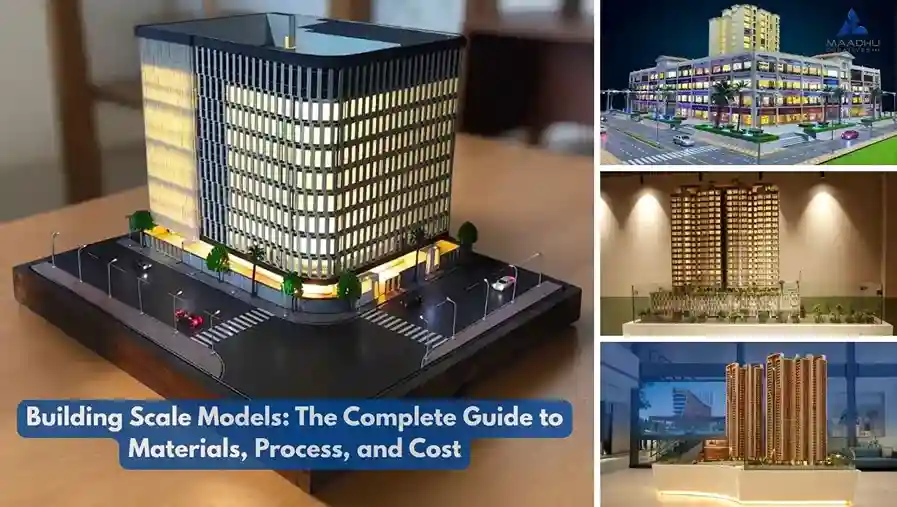
Building Scale Models: The Complete Guide to Materials, Process, and Cost
Present your architectural vision with confidence! Explore building scale models, compare materials, understand the making process, and plan your budg...
Read More
Maadhu Creatives
•October 12, 2026
Everything About Block Model Making
Learn everything about block model making, including types, materials, creation steps, uses, and how block models help bring architectural designs to...
Read More
maadhu creative
•June 09, 2024