





How 3D Building Design Improves Accuracy and Project Visualization
Table of Contents
Introduction
3D building design is changing our approach to the architecture and construction industries, which are constantly evolving. Modern architectural and construction projects require a degree of accuracy and clarity that is not available through traditional 2D drawing methods. From conceptual plans to marketing projections, 3D design tools like BIM modeling architectural rendering, 3D walkthroughs can help engineers, architects and clients see their building with incredible precision.
This blog explains the ways in which 3D building design can improve project accuracy, increases visualization, and speeds the decision-making process, ensuring that it is successful from the beginning to the end.
Understanding 3D Building Design
3D building design is the process of creating 3D digital representations of interiors, buildings, and landscapes. In contrast to flat drawings, 3D models enable the visualization of volumetric dimensions, realistic textures, and a precise, accurate spatial plan.
Key benefits include:
- Accurateness is improved, as errors in layout or dimensions are easily identified before construction
- Better visualization that allows clients to experience the building’s layout ahead of the day that the brick layer is put down
- A seamless collaboration that allows engineers, architects, and contractors to work in a single model to avoid the possibility of misunderstandings
Through the integration of 3D software for architectural design, 3D floor plans, and architectural visualization.
Key Components of 3D Building Design
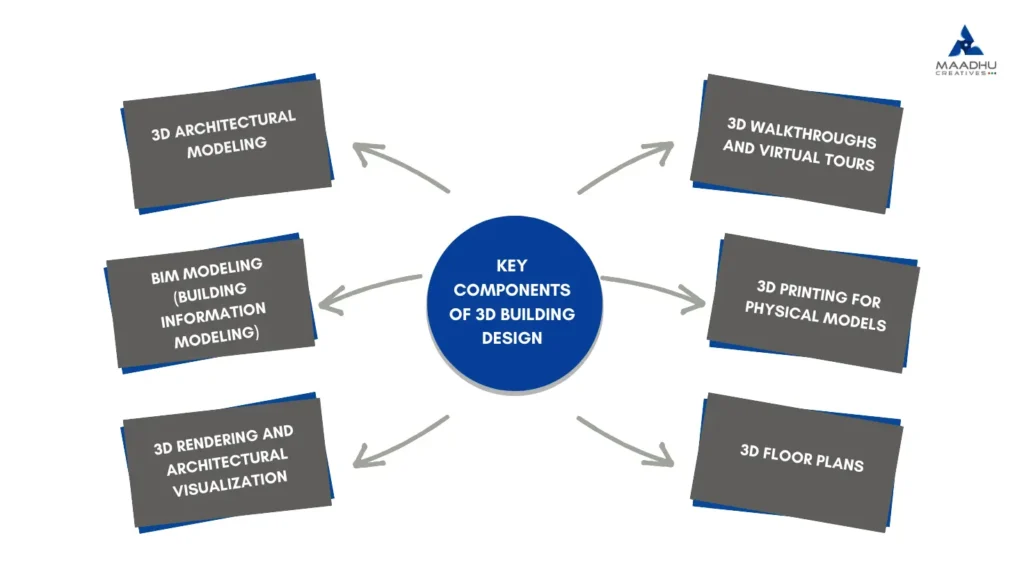
Understanding the key elements of 3D Design will help architects maximise the use of 3D Design as an effective tool for designing and constructing buildings. The following elements or components provide the highest level of accuracy, clarity and seamless coordination at all stages of construction.
1. 3D Architectural Modeling
3D architectural modeling produces an exact digital representation of the structure, including windows, walls, doors roofs, fixtures, and walls. Contrary to 2D drawings the building model offers the view of a volumetric model that makes spatial relations and the design’s intent simple to comprehend.
Benefits:
- Dimensions that are accurate and planning for spatial areas
- Early detection of design inconsistencies.
- Framework is used to create 3D designs, floorplans and architectural rendering and advanced visualization
Software such as Revit, AutoCAD, and SketchUp is often used for contemporary architecture design as well as home design.
2. BIM Modeling (Building Information Modeling)
BIM modeling goes far beyond 3D visuals by including details about structural components, materials as well as HVAC, plumbing as well as electrical and plumbing systems in the model of the building. It is a one source of the truth for all project participants.
Advantages:
- Identifies systems that are in conflict prior to construction
- Offers accurate estimates of materials and schedules
- Improves collaboration between engineers, architects and contractors
BIM is essential for large-scale construction projects. It ensures that construction, design, as well as facility administration are completely coordinated.
3. 3D Rendering and Architectural Visualization
Architectural rendering turns 3D models into realistic images or animations, allowing for the simulation of lighting, textures and shadows. Architectural visualization lets users and others experience the building prior to its existence.
Applications:
- Modern architecture and modern home design.
- Test different colors, materials, and lighting settings
- The marketing of properties or the creation of investor presentations
High-quality renders make the most complex designs understandable and visually captivating.
4. 3D Walkthroughs and Virtual Tours
The 3D Walkthrough and Virtual Tour features allow clients to virtually explore their space’s interiors and exteriors. They give clients the opportunity to have a fully immersive experience, including a true-to-scale, realistic view of how the space will feel and operate.
Benefits:
- Experience the space before it’s built.
- Discover layout and furniture problems while they’re still early in development.
- Increase client involvement in the decision-making process.
These two tools are especially valuable in the realm of high-end residential and commercial property.
5. 3D Printing for Physical Models
3D printing transforms digital building designs into miniatures. Clients and architects can examine the spatial and structural details in a tangible way.
Advantages:
- Visual and tactile understanding of complex designs
- Useful for presentations and design approvals
- Assists construction teams with a physical reference
Mixing 3D printing and digital model bridges for virtual visualization as well as real-world construction.
6. 3D Floor Plans
3D floor plans offer an eye-to-eye view of furniture, layouts or circulation zones. They aid users to understand the space plan in comparison to traditional 2D plans.
Benefits:
- It simplifies interior and space design
- Shows the flow of a room and its connectivity.
- Improves clarity of presentation for clients.
The complete architectural design visualization provided by a 3D floor plan is achieved through architectural rendering and the 3D walkthroughs of the architectural designs.
How 3D Building Design Improves Accuracy
Precision is critical for construction and architecture; incorrect measuring or specifying materials and spatial arrangements can ultimately lead to costly construction delays. Using a 3D Design of the building can enhance precision in the following ways:
1. Precise Measurements
Digital models provide millimeter-level accuracy. This guarantees that each component will fit perfectly.
2. Clash Detection
BIM modeling helps identify the issues between the structural, plumbing and electrical components earlier, and can help avoid problems during construction.
3. Real-Time Adjustments
Design elements that require modifications such as finishes, walls, furniture, or finishes can be made immediately within the 3D model, making sure that there are no repeat revisions.
4. Cost and Material Estimation
Using a digital means of visualizing your project will allow for a more accurate estimation of the materials to be used, therefore allowing for reduced waste, as well as ensuring costs are kept under control.
How 3D Design Enhances Project Visualization
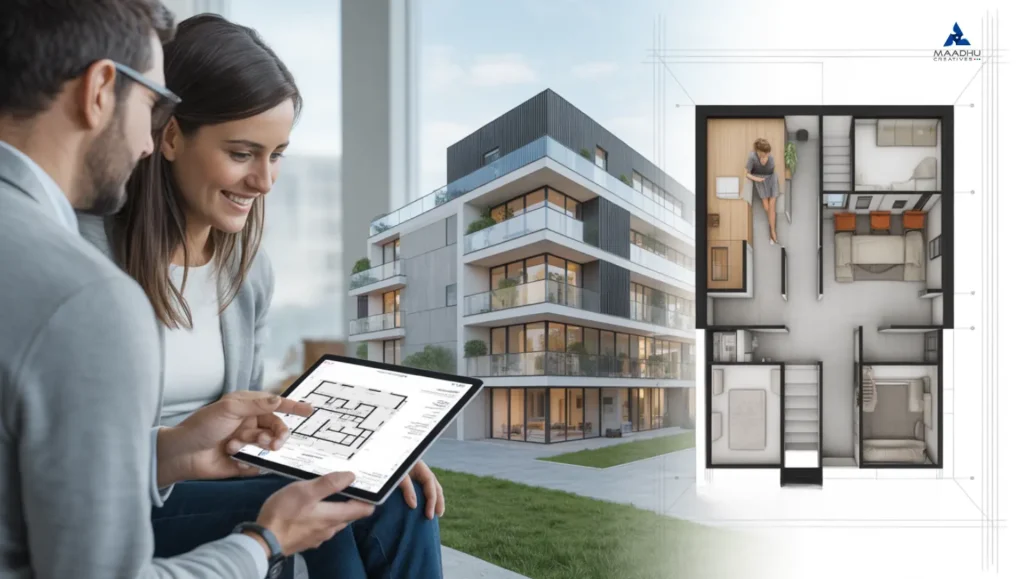
3D design allows for visualisation of the project prior to construction, thereby allowing interaction between clients and architects.
1. Exterior and Interior Detailing
From an accurate 3D floor plan, down through to a highly photo-realistic rendering, your client will be able to envision all aspects of the finished building, from the various areas of each floor, to the exterior finishes, textures and architectural elements.
2. Clear Client Communication
Clients often struggle with 2D blueprints. 3D virtual house tours and architectural rendering make designs tangible and easy to understand.
3. Showcasing Modern Architecture
Providing potential buyers and investment property buyers with visual representations of modern architectural design concepts and layouts allows for increased exposure to contemporary architectural design.
4. Marketing and Pre-Sales
Using digital technologies to produce high-quality 3D walkthroughs and renders will help to market buildings prior to completion, therefore providing potential buyers and investors with the ability to view the building before it is completed.
Advanced Applications of 3D Building Design
Technology continues to grow and offer more applications and ways to utilize the technology.
1. Virtual Reality (VR)
Virtual reality allows your clients to experience a 3D virtual walkthrough of the building as if they are actually inside of it.
2. Augmented Reality (AR)
Augmented reality provides architects and construction teams with a method of placing and aligning their digital models over the top of the physical location of the construction site, and it allows for quality control on the physical site.
3. Sustainable Design Planning
Using simulations, architects are able to design buildings that are both environmentally friendly and sustainable, by studying the sun’s path, winds, and energy efficiency.
4. Team Collaboration
Using BIM Models stored in the Cloud gives the capability for multiple teams to access the same Model at the same time that eliminates the problem & Solution gaps that may exist between teams.
Step-by-Step Process of Implementing 3D Building Design
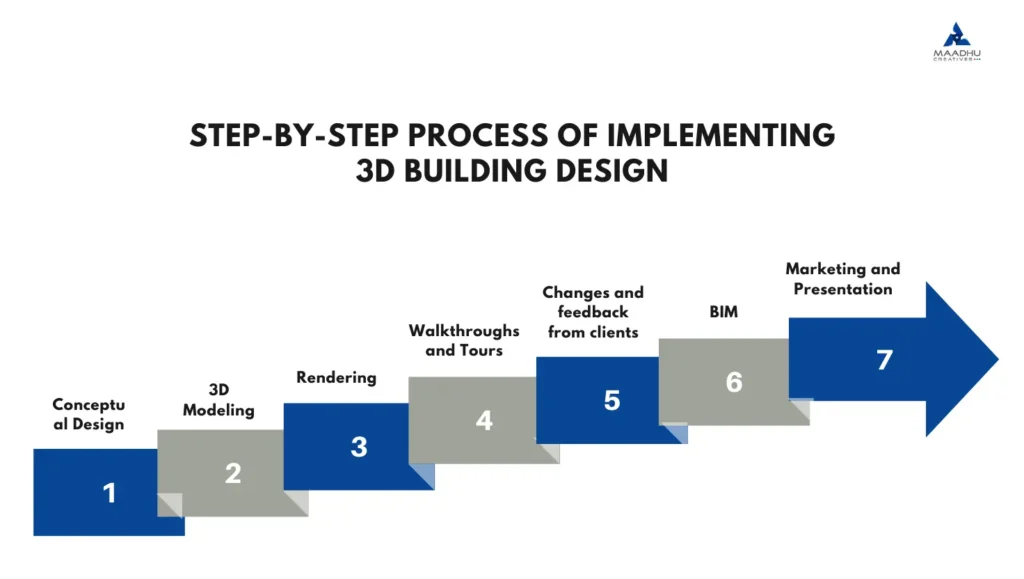
- Conceptual Design: Sketch the basic designs and concepts.
- 3D Modeling: Make an elaborate digital model of your building.
- Rendering: Use lighting, textures and materials to achieve realistic rendering.
- Walkthroughs and Tours: Create virtual tours and 3D walkthroughs of homes.
- Changes and feedback from clients: Change the design based on the feedback.
- BIM: Use BIM models to plan the materials and logistics for construction.
Marketing and Presentation: Create an architectural rendering of marketing and presentations for clients.
Benefits of 3D Building Design
- lowers design errors and costly revisions.
- improves client satisfaction and understanding.
- provides accurate exterior and interior images.
- encourages energy-efficient and sustainable design planning.
- promotes cooperation between locations and groups.
- permits cutting-edge uses like AR, VR, and 3D printing.
Conclusion
The future of architecture is completely altered and hence changed by advances in the technology of 3D Building Design. A fusion of creativity, technology, and precision has allowed us to bring the physical world of construction and imagination together as one entity. With the ability to view designs in three dimensions, Architects now have an easier means to convert design concepts into reality and to link the design process with the construction process by allowing architects to work with their clients in a seamless and natural way, which provides for a more cooperative and streamlined means of productive communication.
Frequently Asked Questions
3D architectural design is focused on visual representations of a structure, while BIM modeling incorporates mechanical, structural, and electrical information to ensure precise construction design and collaboration.
Yes. By detecting errors early, optimizing materials, and reducing revisions, 3D design minimizes waste and labor costs.
Time depends on complexity. Residential projects may take a few days, while large commercial projects can take several weeks for detailed architectural rendering and 3D walkthroughs.
Yes! Using 3D Virtual Home Tours and Walkthroughs clients will have an opportunity to see their project in a 3D format before making a decision to build.